The most interesting problems live in domains I don't know yet, and I've learned to be comfortable in that uncertainty.
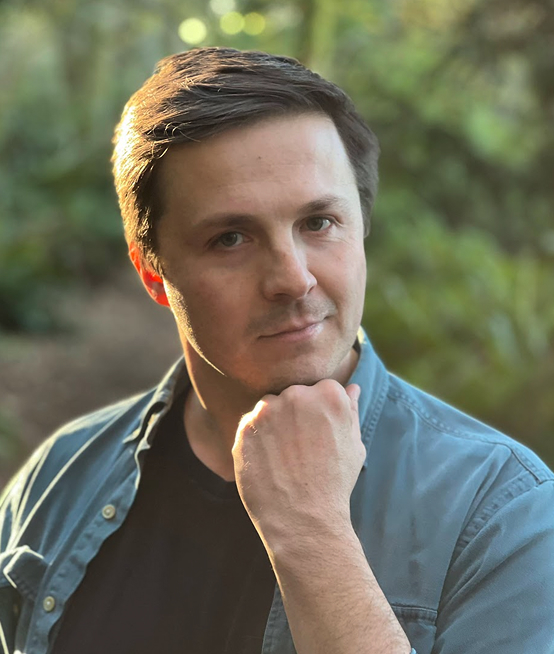
I'm Christopher Seeds, a lead product designer who gravitates toward complex, under-explored systems: commercial insurance, mental health care, music distribution, impact analytics.
When I join a team, the first weeks are deliberate immersion. I talk to the people who've been there longest, read the docs others ignore, and sit with the existing product until the real problems surface — not the stated ones, the actual ones.
Design is how a team thinks together, not just what they ship.
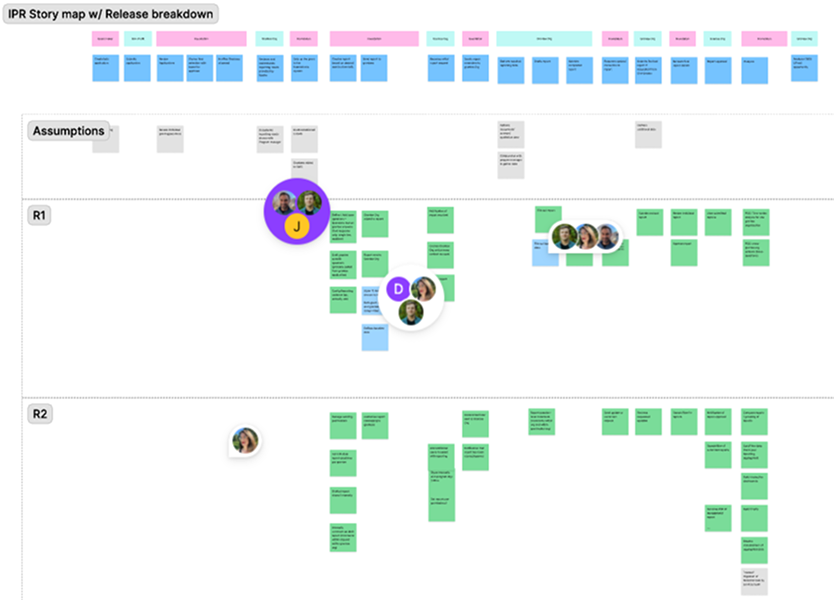
Before I touch a wireframe, I'm mapping flows, decisions, and data structures so the whole team can see the mental model, argue with it, and improve it.
Once the structure is clear, I prototype the longer-term vision quickly — increasingly using AI tooling to make the future tangible sooner. Then I work backwards: stripping features and reducing scope until what's left is small enough to ship now and strong enough to point to what comes next.
At a lead level, I work in a player-coach capacity — owning the design strategy for a problem area, partnering with PMs and engineers from discovery through delivery, and making tradeoffs explicit instead of implicit.
I care about design systems as living infrastructure, not ornament, and about mentoring designers so they can hold more of the problem themselves with confidence.
METHODS I RELY ON
- Service blueprints and system diagrams to align clinical, ops, and product on the same picture.
- Structured discovery — interviews, contextual inquiry, and pilot debriefs — to separate stated problems from actual ones.
- Prototypes at multiple fidelities (from flows to high-fidelity, data-aware UIs) to test ideas with real constraints in mind.
- Design systems treated as infrastructure, not ornament — patterns that speed teams up instead of boxing them in.
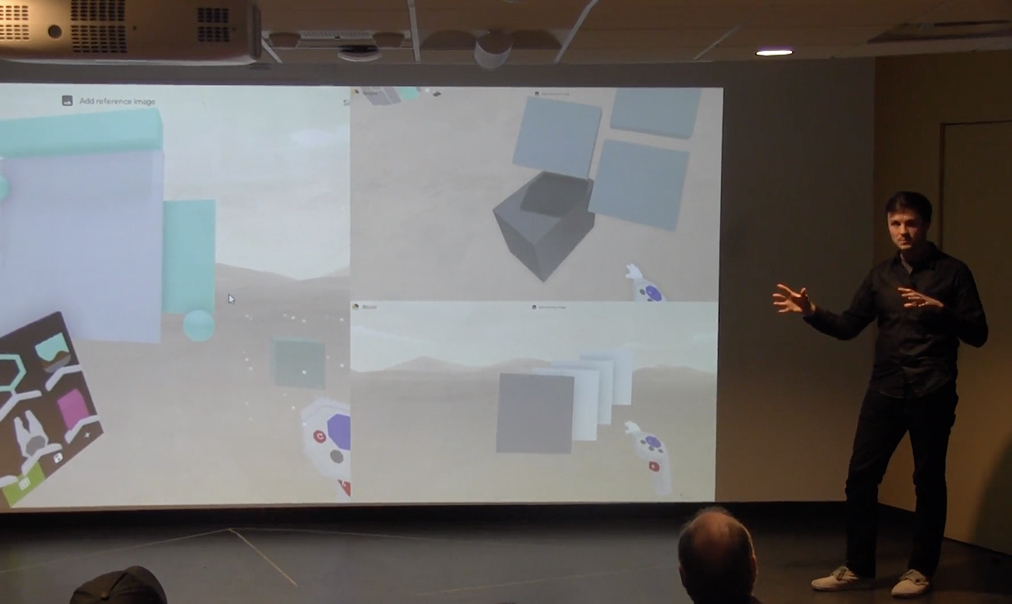
Speaking at UW on how rapid prototyping brings immersive experiences to life and speeds up decision-making and validation.
The problems changed. The complexity didn't. The methods had to.
I've spent the last 15 years choosing roles that move me toward harder problems, less charted territory, and more systemic impact. Grad school was my formal entry point — studying wicked problems and design methods — and the work since has been applied proof of those ideas.
I'm drawn to teams working toward a more just and equitable future, and to products designed with their full lifecycle in mind — where the energy, infrastructure, and attention they consume are treated as real costs.
—
Outside of work, I build things out of scrap wood in the garage with my young child. There's no better teacher than a material that pushes back.